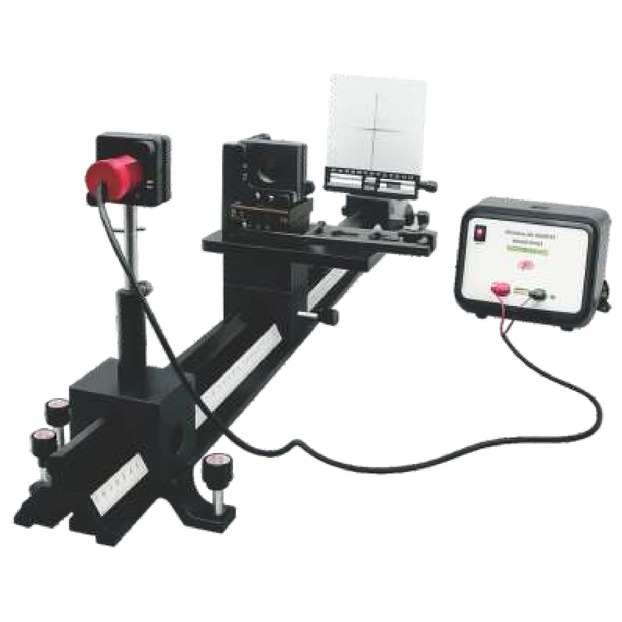
Fabry-Perot Interferometer
In a Fabry–Perot interferometer, the distance between two partially reflecting mirrors is precisely controlled using a combination of coarse and fine translation stages, typically driven by micrometres.micrometres.
In a Fabry–Perot interferometer, the distance between two partially reflecting mirrors is precisely controlled using a combination of
coarse and fine translation stages, typically driven by micrometres. One mirror (or beam splitter) is fixed, while the other is mounted on a translation stage via a two-axis kinematic mount. This mount allows for fine adjustments in tilt to ensure the mirrors remain parallel, which is critical for accurate interference measurements.The interferometer relies on multiple internal reflections between the two parallel, partially reflective plane mirrors. The constructive and destructive interference of the multiple transmitted and reflected beams results in distinct interference patterns. These patterns are highly sensitive to the mirror separation distance 'd', the wavelength of the light used, and the alignment of the mirrors.
Consist of:
> Optical rail one meter long Cat. No. 1240b
> One nos. Standard Triangular mount carrier Model MC-S
> Diode Laser with Kinematic mount
> Fabry-Perot Interferometer with rail carriage
> Translucent screen with rail carriage
> The instrument is complete in itself