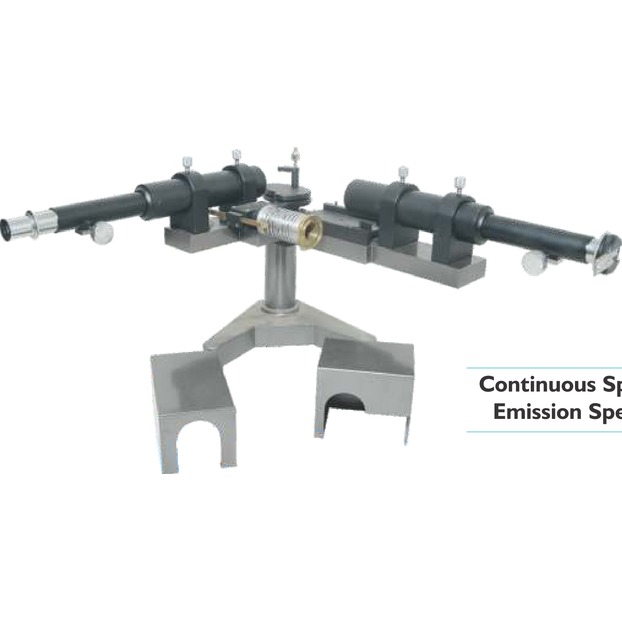
Constant Deviation Spectrograph (C.D.S)
This spectrometer was made in circa 1920 by the Adam Hilger company. It consists of a cast – iron stand with two aluminium arms
This spectrometer was made in circa 1920 by the Adam Hilger company. It consists of a cast – iron stand with two aluminium arms. When in use, light travels through one of the aluminium arms of the device (the collimator) and enters the prism located at the center of the device (Prism Table). Here, the different wavelengths of light are refracted and can be viewed through the second arm (the telescope). The collimator houses an adjustable circular slit, able to reduce the viewing area to a small rectangle. This improves the accuracy of the device and reduces eyestrain.
Unlike the standard prism spectrometer, the telescope cannot be rotated and the base on which the prism sits rotates instead. The shape of the special prism ensures that the final deviation of light rays that pass through the prism is always 90° and rotating
the prism allows different wavelengths to be viewed. The turntable on which the prism sits can be rotated by turning a
screw with an attached calibrated drum. The user of the device may rotate the turntable until they can observe light through
the telescope. At this point, they can read the wavelength of the light from the drum. (Alternatively, the spectra can be recorded by a plate camera or CCD Camera).
Collimator
inner tube Diameter : 44mm
Outer tube Diameter : 50mm
Diameter of Achromatic Objective : 44mm
F.L. of Achromatic Objective : 350mm (14”)
Focus : By Smooth Rack & Pinion (Approx 2.5” motion )
Slit : Circular Slit
Telescope
Inner tube Diameter : 44mm
Outer tube Diameter : 50mm
Diameter of Achromatic Objective : 44mm
F.L.of Achromatic Objective : 350mm (14”)
Focus : By Smooth Rack & Pinion (Approx 2.5” motion )
Ramsden Eyepiece : 10x
Crosswire : Fine Quality Crossline Graticule